

Table of Contents
At a time when the work environment is becoming increasingly dynamic and has a stronger impact on employees’ mental and physical health, companies are beginning to recognize the importance of a holistic approach to wellbeing.
One of the pioneers in this field in our country is Vlatko Milchevski, a physiotherapist with over 17 years of experience and the founder of My Spa – a brand distinguished by its personalized massage services at the workplace, at home, and in its studio.
We spoke with him about how massages are becoming part of corporate culture, the effects they have on employee productivity and morale, and the key steps for companies that want to invest in a truly effective wellness program.
While preparing for this conversation, we noticed that My Spa began with a simple belief — that everyone deserves to feel their best. How did the idea for mobile massage come about, and what inspired you to transform the traditional concept of massage into a personalized service for the home and office?
Exactly — it all started from a simple but powerful belief: that every person deserves a moment for themselves, a moment of peace, relaxation, and genuine care. The idea for mobile massage was born from the needs of the modern individual — someone who lives fast, under constant stress, and rarely finds time for self-care. That’s why we decided to bring the spa experience directly to where it’s most comfortable — the home.
The idea for corporate massage came naturally, as an extension of our mission to make wellbeing accessible where it’s needed most. The workplace is often a source of stress, tension, and physical fatigue. We began working with more and more companies looking for ways to improve their atmosphere, motivation, and the mental health of their teams. That’s why we designed practical, efficient services that can easily fit into the workday without disrupting the workflow — yet with a remarkable impact.
Through regular office massages and specialized wellbeing workshops, companies invest in what matters most — their people. This isn’t just a perk; it’s a tool for building healthier, happier, and more focused teams. When employees feel that their wellbeing truly matters, the results speak for themselves: less stress, fewer absences, and higher productivity.
At the same time, we’ve developed a professional studio where we offer personalized massages with an individual approach to each client — a quiet, modern space designed to provide a complete spa experience. Clients can choose what suits them best: the comfort of home, the practicality of the office, or the deep relaxation of our studio.
More and more companies are recognizing stress as a “silent enemy” in the workplace. How can massage therapy help combat chronic stress and fatigue among employees?
Stress has truly become part of everyday life — silent, constant, and often underestimated. Among employees, it manifests as fatigue, irritability, loss of focus, and decreased productivity. In this context, massage isn’t a luxury — it’s a tool for maintaining balance.
By releasing physical tension and activating the parasympathetic nervous system, massage helps lower cortisol levels (the stress hormone), improves blood circulation, and creates a deep sense of relaxation and relief. Even short sessions during the workday can make a significant difference, leaving employees calmer, more present, and more focused.
At a time when burnout is becoming increasingly common, massage offers a practical, natural, and effective way to prevent it. And when a company integrates it as part of its workplace culture, it sends a strong message — that health and wellbeing are not secondary concerns, but a true priority.
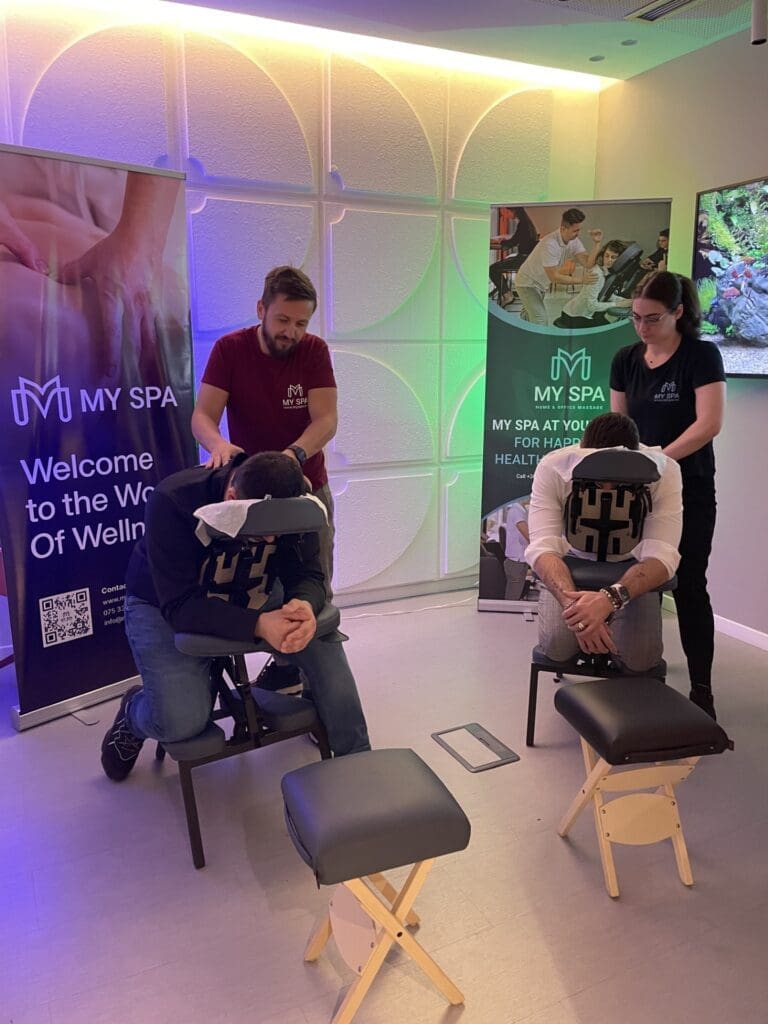
Organizing office massage may sound simple, but it actually requires careful logistics. Could you walk us through the entire process — from the first contact with corporate clients to the on-site execution?
At first glance, office massage might seem like a simple concept, but behind the scenes lies a carefully planned and precisely executed logistics process. Our goal is for the client to not worry about a single thing — we take care of everything.
The process begins with the initial contact — usually via email or phone — where the company shares its needs: number of employees, massage duration, budget, frequency, and available space. Based on that information, we create a custom proposal and schedule tailored to the company’s dynamics.
Next comes the organizational phase — we provide a detailed plan and timetable, coordinate appointments with the designated company contact, and (for larger teams) even offer a digital booking platform where employees can select their own time slots. Then, our professional team of physiotherapists arrives fully equipped: massage chairs or tables, disinfecting supplies, relaxing music, ambient lighting, and even aromatherapy if requested. Everything is mobile, flexible, and fully adjustable to the workspace.
On-site, sessions are carried out with maximum respect for the work environment — no noise, no disruption — always focusing on quality, professionalism, and creating a calm experience for every participant. After each session, we collect feedback from both employees and management, which helps us make every future visit even better.
In the end, the entire process is designed to be effortless for the client — and powerful in its results.
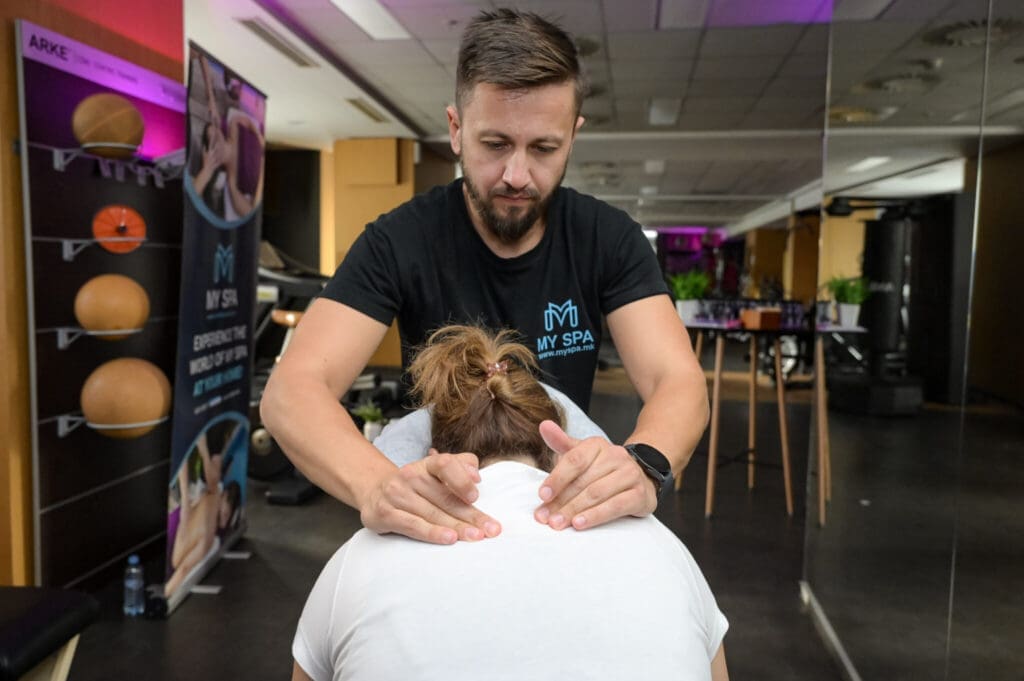
The greatest compliment is when a company that initially wanted to “try it just once” becomes a regular client. That’s when we know we’ve truly met a genuine need.
There’s no universal solution when it comes to pain, tension, or relaxation, as every person is different — both in pain tolerance and in how they respond to treatment. How do My Spa’s therapists adapt each session to the individual needs of every employee?
Excellent question — it really touches the essence of My Spa’s approach to every client.
At My Spa, we believe that the body speaks — we just need to know how to listen. There isn’t one solution that works for everyone; pain, tension, and the need for relaxation are deeply individual. Some people struggle with chronic tension in the shoulders and neck, others with lower back sensitivity, while some simply want a light, soothing massage after a long week.
Our physiotherapists never follow a pre-set routine — each session begins with a brief, focused consultation with the client. It might last just one or two minutes while the body warms up, but it’s enough to set the right expectations: where the pain is, whether there are sensitive areas, what pressure and pace the person prefers, and whether there’s any medical condition that should be considered or addressed.
Our goal is not to deliver “copy-paste” massages, but to build trust and achieve results — treatments that are personalized, targeted, and effective. That’s the difference between simply touching the body and truly helping it heal.
You work with reputable clients such as A1, NLB, NOVA International Schools, Skopje City Mall, Pivara Skopje, Replek, and others. What kind of feedback do you usually receive, and what do you think convinces HR teams to choose this program?
We truly have the privilege of collaborating with respected companies such as Makedonski Telekom, Replek, NLB, NOVA International Schools, Skopje City Mall, Pivara Skopje, the U.S. Embassy, and many others — organizations that take employee care seriously. The feedback we receive is outstanding — not only from employees but also from HR teams. People immediately feel the difference — not just as physical relief, but also as a form of psychological support during the workday.
What convinces companies to join this program is precisely the balance we offer — professionalism combined with simplicity in execution. There’s no disruption to the workflow, no complicated logistics, yet the effect is felt instantly. The program may look effortless, but behind it stands experience, structure, and a team that knows how to adapt to any corporate environment.
Additionally, our transparent communication, flexible contracts, and the option for long-term collaboration including wellbeing workshops make this program not only attractive but also a strategically smart decision for any HR team thinking long-term.
Not every company immediately embraces the concept of wellness in the workplace. What are the most common obstacles organizations face before deciding to introduce this type of service — is it logistics, skepticism, budget, or something else?
It’s understandable that not every company immediately decides to introduce a wellness program in the workplace. The most common reasons for hesitation are logistics, skepticism about the results, and, of course, budget limitations.
Some organizations think it will be complicated to organize — that it will take up time, space, or disrupt the workflow. Others question whether this is something they truly need or just a temporary trend. And yes, budget is always a factor, especially when it comes to something that isn’t easily “measurable” at first glance.
We completely understand that — which is why our approach is to offer flexible solutions: no long-term commitments at the beginning, the option for a trial session, and full support with the organization. Our goal is to show that this can be simple, practical, and genuinely applicable.
Our mission isn’t just to provide a service — it’s to help companies see the bigger picture: that wellbeing is not a luxury, but an essential part of a sustainable and modern workplace culture.
What would be your advice for companies that want to invest in employee wellbeing, but don’t know where to start?
Our advice is simple: start small, but start now. You don’t need to implement a full wellbeing program right away — it’s enough to take the first step and listen to your employees’ needs. That could mean organizing a pilot massage session, a short stress management workshop, or even just a simple survey to understand what people are missing.
What truly matters is the initiative — the signal a company sends: “Your health and wellbeing matter to us.” That alone builds trust, loyalty, and motivation — things you can’t buy with bonuses or reports.
At My Spa, we often work with companies that want to begin but don’t know how. That’s exactly why we’re here — to help with ideas, structure, and practical solutions tailored to each organization’s capacity and rhythm. Wellness culture doesn’t happen overnight, but every step forward makes a difference.
And one final piece of advice from us:
Create a culture where people want to be part of the team — not because they have to, but because they want to.
That’s where real energy, progress, and team strength are born — the kind that drives a company forward.